Saturday, May 3, 2025

No. The Universe NEVER expanded faster than light

The expansion of the universe, according to General Relativity, does NOT occur at a fixed speed. So it is meaningless to say it is faster than light. The units of speed are distance/time. The Hubble Constant (which should be called the Hubble parameter since it changes with time) is around 70 km/sec/Mpc. Mpc is a megaparsec, a million parsecs, about 3.26 million light years. The units of expansion are (distance/time)/distance. This is 1/time, that’s NOT a speed. 

What the expansion rate does is relate apparent velocity to distance. This is the observation that Hubble made. Things in our universe seem to be moving away from us at a speed that depends on their distance. Specifically: V=D*H. The apparent velocity equals the distance times the Hubble parameter.

So the relative speed depends on distance. Giving a single speed is just wrong. For points close enough the relative speed was NEVER faster than light. For any nonzero expansion rate, if the universe is big enough, and you consider points far enough apart, there are always some points separating at faster than light. So superluminal expansion seems to be always happening, but if you think about it more carefully it never is. What is happening superluminally is recession.

This is true now and it was true during inflation. Now the distance needed to produce an apparent superluminal recession speed is very large, but not infinite. During inflation the distance required to get a subliminal recession speed was very small but not zero.

This very common error has been addressed by others. Here's what Sean Carroll has to say about it.

Tuesday, January 30, 2024

NO ... Vibrating atoms aren't key to Atomic Clocks

 I keep seeing articles and posts that say that atomic clocks are based on the vibrational frequency of atoms. I even see very specific, but still incorrect, claims that the current definition of the second is the time needed for cesium atoms (sometimes even getting the isotope right) to complete 9,192,631,770 vibrations.

This obviously can't be true. Atomic vibrations are temperature dependent, so they can't be the basis of accurate clocks or, even worse, a standard of time. So why does this keep getting repeated? I don't know who first got this wrong but I suspect it doesn't matter. This error is so easy to make that it would occur spontaneously even if all examples were eliminated. The standard for a second, and atomic clocks in general, rely on atoms and are based on a vibrational frequency. But it isn't the atoms that are doing the vibrating.

Atoms are held together by the electromagnetic forces between their components. Different configurations have different energy. In the case of the cesium atomic standard, we consider the lowest possible state of all of the electrons in the cesium atoms. This will result in a single unpaired electron. That's what gives cesium its high chemical reactivity. The nucleus of the particular isotope of cesium (Cs-133) acts like a tiny magnet. The electron does as well and those two magnetic fields can orient, with respect to each other, in only two ways. Normal magnets can be in many orientations to each other but not these. This seemingly absurd statement is one of the fundamental aspects of Quantum Mechanics. If you take a Cs-133 atom in its overall ground state and expose it to just the right frequency of EM radiation it will absorb some of it and flip to the other electron-nucleus state. These two states are very close in energy so they are called a hyperfine state. This EM radiation needs to be, you guessed it, 9,192,631,770 Hz. When the Cs-133 atoms drop into the lower state they emit EM radiation at this frequency.

The Cs-133 atoms in atomic clocks are NOT what is vibrating. It is the electromagnetic field of the radiation involved in their state change.

Saturday, January 13, 2024

Uhm ... NO!

As the name of this blog indicates I'm more concerned about getting everything, even the little things, right than most people. There are a bunch of groups and pages on Facebook that portray themselves as being pro-science yet post material that is, in my opinion at least, rather poor quality. A Facebook friend posted something from one of these. I responded by saying that this was the kind of thing that H.L. Mencken had in mind. Referring to the maxim that for every question there is an answer that is clear, simple, and wrong. Pointing out the ways that the post was wrong in a comment didn't seem appropriate so I'm doing it here.

It starts out without obvious error but promising to "disregard all of the finer details" may not mean what the reader would think.

This is going to be quick and simple. I’m going to be disregarding all of the finer details and just focusing on the overall role CO2 plays in our climate. 

Next, we read:  

Sunlight reaches earth in 2 forms, longwave radiation, and shortwave.

This is somewhere between untrue and meaningless. If "Sunlight" refers to visible light it is, at best, meaningless. There is no sensible way to divide the visible spectrum in two. If it means any electromagnetic radiation it is even worse. There are more than two categories. After reading the rest of the post, the "best" interpretation is that infrared and visible light are longwave and shortwave respectively. For discussions of climate, those are the two kinds of light that matter. But infrared radiation from the Sun isn't the infrared that matters.

Of the shortwave radiation that hits the ground, less than half is absorbed by water, plants and everything else; the rest is bounced back towards space. 

This is just plain wrong. The albedo of the Earth is about 0.3. This means that about 70% of the energy is absorbed, far more than the "less than half" in the post. This error is strange for two reasons. It is trivial to get right and it doesn't matter to the story at all. 

When the radiation bounces off of a surface and heads back towards the atmosphere, it is converted from shortwave to longwave.

This is also just wrong. Visible light that "bounces" or reflects is not converted to infrared. Infrared radiation is emitted by everything at the temperatures we are accustomed to. This is a vitally important difference because it allows the radiation to come from both the day and night sides of the Earth. The post describes a nonexistent process that would only be active during the day. In reality, infrared radiation is given off by everything that is at the temperatures we are accustomed to.

It’s longwave radiation that reacts with molecules in our lower atmosphere. Molecules such as carbon-dioxide, nitrous-oxide, and methane. Of these gasses, CO2 currently makes up 76% of the total.

This seems to be a list of the greenhouse gasses in the atmosphere but it is missing the most powerful greenhouse gas: Water vapor. If you ignore Water vapor and all of the major gasses in the atmosphere then 76% is a reasonable estimate. I guess that the actual percentage of CO2, 400 ppm or 0.04% in the atmosphere, is too small to seem important. 

When the outgoing radiation interacts with these molecules, they absorb it and give off infrared radiation in all directions.

The radiation leaving Earth has two main sources, reflected visible light and infrared, Only the infrared light is absorbed by greenhouse gasses. There is another subtlety at work here, the absorption of infrared light is far from uniform. This is needed to get any of the details right, but at this level of explanation, it can safely be ignored.

This is the first time that "infrared" is used. Introducing it now makes everything preceding this point at best unclear.

The fewer the molecules in the atmosphere, the more longwave radiation makes it back into space. The more molecules in the atmosphere, the more radiation gets absorbed. It’s basically simple maths. 

This is way past oversimplified but could be almost correct if we continue to assume that by "molecules" they mean molecules of greenhouse gasses. The nitrogen and oxygen in our atmosphere make up about 99% of the total, aren't they made of molecules as well?

When climatologists say that the increase of CO2 in our atmosphere is warming the planet, this is why. This is the science and maths behind that train of thought.

Uhm ... NO! This is NOT the science behind CO2-induced global warming or any train of thought that shouldn't be derailed.

The worst thing about "explanations" like this, at least for me, is that it is possible to actually explain the basics, teach some actual science, and not be wrong. Here's my attempt to address these issues:

To understand how increased CO2 warms the Earth we need to understand a couple of things first. What most people think of as light is really just a tiny part of a larger phenomenon called electromagnetic (EM) waves. A good way to think of EM waves is as things that carry energy, even through empty space. Different kinds of EM carry different amounts of energy. We see visible light but there is a lot of light that is invisible. Another thing we need to know is that everything that isn't at absolute zero emits EM waves. the energy and amount of which increases with temperature.

Sunlight reaching the Earth warms it. That makes the temperature higher and causes the Earth to emit EM waves to carry away some of the energy coming from the Sun. When the average temperature of the Earth is steady the energy coming from the Sun and the energy leaving the Earth are balanced. 

The Earth's atmosphere is transparent to visible light but it is somewhat opaque to the light it emits, infrared (IR) light. This makes the energy leaving the Earth less efficient, raising the temperature. Without this the Earth would be much colder than it is. Although CO2 makes up a tiny fraction (0.04%) of the atmosphere, it is one of the major ingredients that reduces its transparency to IR. When we add CO2 we change the balance and the Earth heats up.

The first paragraph should be stuff that everyone knows and therefore not important. But, as a pedant, I felt it was worth including. 

Friday, September 1, 2023

A Different View of Quantum Mechanics

I see lots of articles and posts about Quantum Mechanics (QM). Most, including the ones written by professional science communicators, are written by people who have such a tenuous grasp of the subject that they misinform far more than they inform. Others do have a good grasp of the subject but they violate a rule that I think is far more important than most people do: Simplify as much as possible, but no further. If you need to oversimplify then either your explanation needs to be better or your subject isn't appropriate for the level of understanding you assume your audience has.

The best models of reality that we have are in a category known as Quantum Field Theory  (QFT). Any attempt to explain it would violate the rule I stated above so I'm going to just use a few ideas from it. There exists everywhere in space a field that corresponds to each fundamental "particle". Fields are abstract entities that are very common in physics and some of them aren't too hard to wrap your head around. You can represent the temperature in a room as a temperature field, the value of the temperature at any point in the room. There can also be an air motion, or wind, field. It gives the direction and magnitude of air motion at every point. In QFT there is a field for every type of object. Also, there are wave-like excitations in this field. The wavelength of these waves is related to the momentum of the object. As shouldn't be too much of a surprise, since these are quantum fields, these excitations come in distinct, quantized, elements. These quantized excitations are what we call "particles".

In the first, incredibly successful, QFT there are two fields. The electromagnetic field, a concept that should be familiar to most readers of this, and an electron field. This theory is called Quantum Electrodynamics and it is often, justifiably, called the most accurate theory in all of science. The quantized elements in this theory are called photons and electrons.

These excitations are different from the objects that we experience in everyday life. One of the most important differences is encoded in the Heisenberg Uncertainty Principle (HUP). This is usually, and incorrectly, described as a limitation based on our ignorance. Or the effects caused by attempts to measure the position or momentum of quantum objects. The principle is more fundamental than that. Since objects are wave-like excitations of the underlying field their edge can't be defined in the way that everyday objects are. Like waves, they don't have abrupt edges. Instead, they are spread out. To use a bit of jargon, they can't be localized precisely. You may have noticed that I have avoided the word "particle" and when I did use it it was in quotes. That's because the word "particle" implies that the object can be localized precisely and that is simply not the case.

The most common version of the HUP relates the position of an object to its momentum. As stated above the momentum of the object sets the wavelength of the excitation of the field. So the HUP is a statement about the wave-like nature of QFT objects. The higher the momentum, the shorter the wavelength of the excitation, and the more abrupt its edge can be. One more strange concept will be helpful here. Momentum space. Just like locations are in the space of positions we can imagine an abstract space where positions are values of momentum. With this abstraction, we can state the HUP more precisely. The extent of an object in position space times the extent of the object in momentum space can never be smaller than a certain size.

In practice, this translates into a kind of pressure. Attempting to constrain a quantum object to a confined space requires increasing the momentum of the object so that it pushes against whatever is “holding” it in place. Let's look at that in a particular situation. An electron in an atom. The negative charge on the electron causes it to be attracted to the positive charge of the nucleus. This attraction tends to constrain the electron to be near the nucleus. The HUP acts like a pressure that resists this attraction. These effects are in balance in atoms and we can calculate, to pretty good accuracy, the size of an atom from this effect alone.

It is common to say that the electrons in an atom are whirling around the proton very quickly and the quantum mechanical orbitals are blurred approximations of its position. This is wrong. The electron simply doesn't have a fixed position. It is unlocalized because it is a wave whose extent is determined by the HUP.

Another, but closely related, incorrect statement that you will frequently read is that the atom is mostly empty space. This is based on the same oversimplification as used in the previous paragraph. The volume of the atom is not empty. It has as much electron in it as the laws of physics allow.


Wednesday, June 21, 2023

Lots of Effort, Terrible Result

 On June 13, 2023 a seminar was held at CERN to report some of the results and methods used by one of the major collaborations involved in the LHC. One of the motivations for this work is the fact that there is matter in the universe but very little antimatter. It is expected that whatever created the initial, very hot, universe would have produced as much matter as antimatter. These components would then have interacted and resulted in neither matter nor antimatter, just a lot of photons. We are an indication that this didn't happen.

Beginning in the 1960s and continuing into the 2000s experimental evidence showed that certain particle interactions violated matter/antimatter symmetry. This was incorporated into the Standard Model of Particle Physics back in the '60s. However the asymmetry involved wasn't enough to explain the amount of matter we see.

When the LHC was designed, many decades ago, it was produced with 4 interaction areas. One of these, LHCb, was specifically designed to determine how well the asymmetry predicted by the Standard Model matches experimental results. That shows how important this is to physics. The recent seminar presented the current status of that data analysis and it shows that the asymmetry is consistent with the predictions of the Standard Model.

So why am I writing this? I saw a post that linked to an article that was clearly related to this seminar. It also contained a significant amount of material clearly intended to provide background on the subject for readers that aren't familiar with the field. Why don't I say it was about the results from the seminar? Because what it reported implied the opposite of what actually happened.

Let's look at both articles. One says, correctly, "The weak force of the Standard Model of particle physics is known to induce a behavioural difference between matter and antimatter". The other says, incorrectly, the opposite, "The Standard Model of physics tells us that if we substitute a particle for its antiparticle, it should still operate within the laws of physics in the same way". There are numerous other examples of the second article getting things completely wrong. Most importantly in the way that the seminar's results are portrayed.

The first, the correct one, says "...  the new LHCb results, which are more precise than any equivalent result from a single experiment, are in line with the values predicted by the Standard Model". The other says, the results do "... not fully answer why there is more matter than antimatter in the universe, [the experimental results] will help constrain models that do attempt to explain this strange asymmetry". Although it isn't explicit it inplies that the results show something new, the exact opposite of what is true.

How does this happen? The "journalist" could simply have copied, or slightly reworded, the article linked above. Instead they clearly expended lots of effort. Unfortunately, they had essentially no understanding of any of the physics involved.

I was made aware of this when a link to the incorrect article was posted by a friend. Reading it made it clear that the veracity of the information wasn't trustworthy. A quick search found the article at the top of this rant. I sent the link as a comment to my friend's post. The fact that people are far more likely to come across popular articles on things like this is not a surprise. The problem is that articles like this almost always get some, or in this case essentially everything, wrong.

Wednesday, May 3, 2023

A Superposition of Errors

For a really long time, I've been trying to construct a simple explanation of Quantum Mechanics (QM) that could be understood without a background in the math used in the formal studies of the subject. I hope to eventually do that but there are several subtopics. I'm not sure which to tackle first and I keep getting stuck.

Recently I came across a science blogger's article about quantum computing that said:

Qubits exploit the quantum phenomenon of superposition, the ability for a particle to be in more than one state at once. A qubit can therefore be in any state between 0 and 1 inclusive, and in fact can be in every state from 0 to 1 at the same time.

Yes, Qubits exploit superposition. Essentially every other part of this is wrong. Superposition is not a quantum phenomenon. A qubit is not in more than one state at a time, it is a state formed by a superposition of other states. There are no states between 0 and 1, so a qubit cannot be in a state between zero and one. The assertion that it is "in every state from 0 to 1 at the same time" isn't even wrong.

So, thanks to this "incentive" I'll address superposition.

Superposition is a general property of an enormous category of mathematical relationships. One set of those is used in QM but it is not a "quantum phenomenon".

To explain the rest of these errors I need to explain a bit about superposition.

I'll use light waves as an example. As I hope everyone reading this knows, light is an electromagnetic wave. One particularly simple and useful way to view a light wave is that it has its electric field value changing like a sine wave in a single direction. Light like this is said to be polarized in that direction. 

A particular electromagnetic wave can be polarized in the vertical direction. Another possible wave is one that is polarized horizontally. Electromagnetic waves are in the category of mathematics that support superposition. This means that the sum of any solutions to the relevant equations are also solutions. So we can add the horizontal and vertical waves and the results will also be a valid electromagnetic wave. I chose these options because adding combinations, also known as forming a superposition, of vertical and horizontal waves results in an electromagnetic wave at any possible angle. (For those that aren't spooked by trig functions to set the polarization angle to θ from the vertical component is cos(θ) and the horizontal is sin(θ).) Any linearly polarized light wave can be constructed from a superposition of horizontally and vertically polarized waves. Light that is polarized at some angle to the direction in which the polarization is being measured is not in more than one polarization state at a time. It is a distinct polarization state that is formed by the superposition of other states. 

If we consider light as a series of photons we start to see some of the effects of QM. A photon of light is an all-or-nothing sort of thing. If the photon encounters a polarizing filter it either goes through it or it doesn't. The proportion of photons that will go through is related to the amount of horizontal and vertical polarization in the superposition. Each photon either passes through the filter or it doesn't. There are only two states possible, the photon has an intrinsic "two-valueness".

(The above treatment of polarized light ignores several very important aspects of the topic, like circular polarization and polarization measurements at arbitrary angles. These don't have any relevance to the topic of this entry, and they don't relate to the general topic of superposition in quantum computers.)

This superposition is, mathematically, the same as superposition in the context of quantum computers.

Many quantum mechanical systems can only be in discrete states. Let's consider the (so-called) spin of an electron. The spin, or angular momentum, of a regular object is a vector whose direction is the axis of rotation and whose magnitude depends on the distribution of mass and the rate of rotation. For an electron, the spin behaves in a way that has no classical analog. No matter how the electrons are aligned and no matter what axis the spin is measured along the result is always the same magnitude, either with or opposite that measurement axis. Explaining what this means and why it's so weird is far beyond the scope is this rant. This "two-valueness" is true for all qubits, not just the ones that can be reduced to electrons.

So, how should that article have described qubits? Here's a possibility.

Qubit is a portmanteau of quantum and bit. Qubits take advantage of superposition, a fundamental property of quantum systems that can make any combination of states a possible state. Qubits, like regular bits, have two states, usually called 0 and 1. Superposition allows qubits to be in other states, ones that aren't possible with regular bits, where the value is both 0 and 1 at the same time. When combined with another quantum behavior, entanglement, this greatly increases the amount of information that can be encoded in a set of qubits.

Monday, July 11, 2022

Infrared is NOT heat

There has been a lot of coverage of infrared (IR) astronomy recently and, with the release of the first JWST image, this should continue. One of the most common things I've come across in this area is the assertion that IR radiation is heat.

It isn't.

To explain why very knowledgeable people say this and why it is wrong will take a bit of explanation.

First, let's talk about light. For the average person that's a really familiar topic. Light is the stuff we see. But we can do better than that. It has been known since 1865, when James Clerk Maxwell derived the speed of electromagnetic (EM) waves, that the light our eyes can see is just one kind of electromagnetic wave. Let's call that visible light. The study of electricity and magnetism (E&M) is very mature and, without going into any detail here, one of the very well understood aspects of E&M is that energy can be sent through space as a wave of intertwined electric and magnetic fields. These all travel at the same speed and the speed derived from Maxwell's Equations is the measured speed of visible light.

It was noticed by William Herschel in 1800 that a prism produces more than just the colors that we can see. If you take light from the Sun and pass it through a prism, as was done by Newton, it is split into a fan of color in the familiar pattern of a rainbow, Red-Orange-Yellow-Green-Blue-Indigo-Violet (or not so familiar since indigo isn't a color we encounter often). Herschel was interested in the amount of energy in different colors of light. Thermometers with blackened bulbs were placed so that different parts of the spread-out sunlight would heat up the thermometers. He also noticed that a thermometer placed past the red light coming out of the prism would also heat up. In fact, the thermometer beyond the red got even warmer than the one in red light. This showed that there is something coming from the Sun that transferred energy, was bent by a prism, and was not visible. We have since learned that there are a wide range of EM waves that physicists call "light". Everything from radio waves to gamma rays. Only a tiny fraction can be seen with our eyes and are called "visible light". This is even true for sunlight. Less than half of the energy emitted from the Sun is in visible light. A bit more, still less than half, is IR. Most of the rest is ultraviolet (UV).

Next, let's talk about heat. All matter is made of molecules. These molecules are moving around, even in a solid. That kinetic energy, the energy of motion, is what heat actually is. When an object absorbs more energy it gets warmer. This is true no matter how hot the object is.

What kind of energy is emitted by an object at a given temperature? You probably remember that heat is transferred in three different ways: Convection, conduction, and radiation. Since we're going to be talking about objects that aren't touching anything, only radiation matters. What determines the properties of the radiation given off by an object? This is another fascinating topic but the most important things to know are:

1) The radiation given off is EM waves

2) (almost) All objects made of (almost) any material give off (almost) the same radiation when at the same temperature. (The "almosts" will be ignored from now on.)

3) All objects (at a nonzero temperature) give off the most radiation at a wavelength that gets shorter as the temperature gets higher.

4) If object A is at a higher temperature than object B, object A will give off more radiation than object B at ALL wavelengths. 

For objects that are a few thousand degrees that peak is in visible light. For temperatures in the millions of degrees it is in X-rays. For the coldest objects warmed only by the cosmic background radiation it is microwaves. All of these types of radiation tell you (something) about the temperature of the object giving off that radiation. 

What happens when various forms of EM waves are absorbed by an object? When the energy in that wave is absorbed it heats the object up. This is true of all forms of EM waves. This highlights the first misconception caused by saying that "Infrared is heat". Most people think that IR is particularly good at heating things. It is, but not because IR is heat. It is because most of the materials we deal with our day-to-day lives absorb IR quite strongly. This is not true in general.

The association of IR with heat is mostly an accident of the way it was discovered and the temperatures we normally experience.

IR is useful in astronomy NOT because of this association. Here are a few of the reasons that an IR telescope is useful

We think of space as empty, and compared to what we usually experience it is. But there are large volumes that contain lots of dust. That dust absorbs visible light. It absorbs IR far less. This allows us to see inside these clouds or even through them. This has allowed us to track individual stars as they orbit the supermassive black hole at the center of our galaxy. This work won a recent Nobel Prize in Physics.

As the universe expands light that is traveling expands with it. The earliest stars that we think exist have most of their visible light shifted into IR. That means that we need to be able to detect IR light to see them.

Different molecules absorb light in characteristic patterns in many different parts of the EM spectrum. Many of the most interesting constituents of planetary atmospheres have their most distinctive absorption features in IR light.

Many of the asteroids in our solar system reflect very little of the light that illuminates them. This means that they are very faint. But absorbing that light means that they warm up and emit light, much of it is IR light.

Being able to explore the universe in IR with JWST is sure to teach us a LOT. But it isn't because IR is heat.

Friday, December 17, 2021

The Dangers of “Good” Science Communication

One of the central lessons I have learned from my time in the Skeptic community is that the veracity of information isn’t the primary factor in determining what people accept as true. Some groups have known this for a very long time. The practices of the advertising and marketing sectors are largely determined, whether they realize it or not, by the psychology of belief. In our highly connected, ad driven world, the importance of how to use the largely unconscious factors that affect attention and acceptance is central to success. This has worked its way into almost every aspect of our lives. One of my favorite science YouTube channels recently did a video about some of the things that affect the popularity of a video and interactions with the algorithm that determines how often that video is presented and to whom. The subject has also come up in print as various science communicators talk about the importance of headlines and the way they present information. As all of these people get better and better at presenting information in a way that appeals to our psychology they are able to make content that is more convincing and more likely to “go viral”. I see this as a significant, and essentially ignored, danger. People can be wrong. The more expertise you have in a field the less likely you are to be wrong. This is a particular danger in science communication. The material is often quite subtle. Without sufficient expertise in the subject material, it is likely that the message will misinform as much, or even more, than inform. This is fairly well understood and recognized, at least in the abstract. As Neil deGrasse Tyson put it recently in the ad for his MasterClass: “One of the great challenges in life is knowing enough to think you're right but not enough to know you're wrong”. As science communicators get better and better at presenting their material in a convincing manner the material is more likely to stick in people’s memories. When they present incorrect information, in this more convincing manner. their audience accepts it and remembers it even better. Let’s consider a specific, quite narrow, topic: waste from Thorium reactors. The amount of misinformation on this subject is enormous. I’ve seen trusted science communicators assert that the waste from thorium reactors is far less radioactive and has a shorter half-life than that of current reactors. This is not only wrong, it reinforces a fundamental misunderstanding of the subject. If something is less radioactive it has, by definition, a longer half-life. That’s simply what the words mean. It is impossible for something to be both less radioactive and have a shorter half-life. The half-life is the length of time needed for half of the sample to decompose due to radioactive decay. A substance with a very long half-life is very difficult to distinguish from one that is not radioactive. This mistake is often made in the opposite direction. You will see pronouncements about the danger of “highly radioactive materials with a long half-life”. Such materials, by definition, can not exist. One science communicator, popular among skeptics, explained that material in a thorium reactor is “completely burned” so it “has had almost all its radioactivity already spent”. As if radioactivity is a substance that is released in nuclear reactors. Not only is this not the way it works, it encourages people to think of reactors in ways that are simply wrong. Such misinformation can only make things worse. When that misinformation is skillfully communicated it does so to a greater extent. I have written about this type of problem before. That post was about the use of “whiz-bang” visuals, one of the many ways a video is made more appealing. So what can be done? A simple, fairly effective solution is both obvious and not practical. Restrict science communication to people that are true experts in the field being communicated. Another, slightly more practical option, is to get science communicators to confirm what they say with subject matter experts. Yet another option is for topics, like the characteristics of spent fuel from thorium reactors, which need lots of background information to be comprehensible, to be out of bounds for science communicators


Wednesday, November 10, 2021

Nuclear Waste as Nuclear Fuel? Not really.

I keep running across the assertion that nuclear waste can be used as nuclear fuel. In several cases it is asserted that it is only regulations that prevent this use. One went so far as to say "[W]hat’s the difference between nuclear fuel and nuclear waste. The scientific answer is really nothing, there is no difference. The only difference is a technological one. Nuclear fuel is radioactive material we know how to burn as fuel and radioactive waste is nuclear material we don’t know how to burn as fuel but there is no other real, physical difference between fuel and waste. It’s a technological difference only."

The quote in the previous paragraph is simply false. As will be explained below, nuclear waste, no matter what reasonable definition you use, contains a significant amount of material that cannot be used in a nuclear reactor. For the rest of this I'll address the more reasonable versions of the assertion.

To honestly make the claim that nuclear waste can be used as nuclear fuel several additional, and extremely important, details need to be added. Here's an overview. Details follow.

It is helpful to think of two types of fuel, active fuel and potential fuel. Active fuel undergoes a reaction that releases large amounts of energy, allowing the reactor to generate power. Potential fuel undergoes a reaction (or reactions) that convert it to an active fuel. In our day to day world only active fuel is thought of as fuel. Most current nuclear reactors use U-235 as active fuel and in normal operation almost all of it is used up. At the same time a small amount of the U-238, acting as potential fuel, is converted to Pu-239 that then acts as active fuel. All of the uranium originally put into the reactor is fuel but the vast majority is potential fuel and only a small amount of that either starts as or can be converted to active fuel in current reactors. It is sometimes said that the only difference between nuclear fuel and nuclear waste is the type of reactor it is used in. If by "fuel" we mean active fuel, which is the only kind we are familiar with in normal life, this is simply wrong. It is possible to build reactors where virtually all of the potential fuel is converted to active fuel but those reactors are complex and expensive and they require a large amount of complex processing to get anywhere near this point. It should also be noted that these future reactors can NOT be operated using only what we now call waste (more detail below). New, active fuel is needed.

The first problem is that the term "nuclear waste" means entirely different things to different people. For this discussion we'll be considering "spent nuclear fuel". This is a small fraction of the radioactive material produced in a reactor and is the only really problematic material short of a nuclear accident.

For this discussion we can consider most nuclear fuel as just a mixture of two isotopes of uranium. The majority is U-238, about 95% of it. It is potential fuel so it cannot take part in the power generating nuclear reactions. The rest, about 5%, is U-235. This is the active fuel that produces the desired energy in the reactor.

When the spent nuclear fuel is removed most of the U-235 has been used up, it is now <1% of the material. It is converted to what are called fission byproducts. This consists of a wide range of material, some quite radiologically hazardous, but for considerations of use as fuel it is worthless. Some of it is worse than useless. It will absorb neutrons, suppressing the desired nuclear reactions. It is truly waste. A small amount of the U-238 has been converted to plutonium, mostly Pu-239 with a smaller amount of Pu-240 and other isotopes. In total about 1% is plutonium. Some of the uranium is also converted to other uranium isotopes.

The claim that spent fuel is reusable is based on reprocessing. The idea is that by a variety of processes the spent fuel can be separated into components and then placed back into the reactors that it came from. Often the claim is made with numbers attached. Most commonly I've seen it as something like this paraphrased example: "Only around 5% of the energy available in nuclear fuel is extracted in our current reactors. 90% of rest could be extracted if the fuel were reprocessed". 

The 5% number should sound familiar, it is the original amount of U-235. The other 95% is based on the idea that the U-238 can also be used as a nuclear fuel. 

This is almost correct if we are careful when we talk about what kind of fuel we mean and, more importantly realize that it requires a type of reactor that is different than essentially all of the ones currently in use. The fact these issues are almost never mentioned when the claim is made is what makes the claim so misleading. 

To understand this better a bit more background is required. All of the reactors in this discussion are fission reactors. Nuclear fission occurs when a neutron is absorbed by a nucleus and that nucleus splits, roughly in half, and often emits a number of neutrons. There are many isotopes that will undergo fission but the important subset for this discussion are those that emit enough neutrons when they fission that a chain reaction is possible. These are called fissile materials. There are only a few such isotopes and three of them are most important for nuclear power: U-233, U-235 and, Pu-239. Of these only U-235 exists in any noticeable amount in nature. But there isn't much, it is just 0.7% of natural uranium. The remaining 99.3%, is essentially all U-238.

Most power reactors use uranium that has been enriched in U-235 to about 5%. This is done by separating out almost pure U-238, increasing the proportion of U-235. The separated material is known as depleted uranium. Enrichment is done so that the neutrons released by the fission are likely enough to reach another U-235 nucleus and cause a sustained reaction. This results in the 95% U-238 mentioned above. As mentioned above, the operation of the reactor results in some Pu-239 being created, some of it used as active fuel but about 1% of the the spent fuel is plutonium. 

The transformation from the potential fuel, U-238, to Pu-239, is a multi-step process.

U-238 + neutron → U-239
U-239 decays to Np-239 (half-life of about 25 minutes)
Np-239 decays to Pu-239 (half-life of about 2.5 days)

Near the end of the useful life of the nuclear fuel a significant fraction of the energy comes from the fission of Pu-239. It is possible to design a reactor to optimize the production of Pu-239. These are called "breeder" reactors and they produce more active fuel than the active fuel they consume. Breeder reactors sound too good to be true. Producing more fuel than is consumed doesn't seem possible, but it is. That's one of the problems with this entire topic. So much of what happens is so far outside of the intuition developed in our day to day world that we are often lead to conclude things that aren't true.

As an interesting aside, the oft mentioned Thorium reactor is also a breeder. Here Th-232 is a potential fuel that goes through a similar (but slower) multi-step reaction to produce the active fuel U-233, the third fissile isotope.

Current reprocessing of spent fuel produces, among other things, MOX fuel. These are Mixed OXides of uranium and plutonium, current reactors can use this material as a minority of its fuel. Almost all of this is produced by combining plutonium from reprocessing with depleted uranium. Depleted uranium is used because the uranium obtained from reprocessing (RepU) contains various impurities that impede the nuclear reactions and other negative consequences that are beyond the scope here. This is in direct contradiction to the common assertion that this MOX fuel is composed mostly of the reprocessed material and results in more of the potential fuel being used.

In conclusion, there is a lot of misinformation about nuclear power and so called "nuclear waste" much of that misinformation greatly exaggerates the dangers and problem. But a significant amount is being spread by nuclear proponents. Whereas it is possible to process spent nuclear fuel and extract virtually all of the nuclear energy available in the uranium fuel (both active and potential) this is far more complex and expensive than is implied by proponents, it would require reactors that are significantly different than those in use today, and it would not use all of material as fuel. 

Monday, July 19, 2021

Vaccination Fraction and the Base Rate Fallacy

I keep seeing references to the fraction of people with COVID related conditions that have been vaccinated. A recent story implied that the fact that about half of the infections in Israel were in vaccinated people was evidence that the vaccines aren't working. There is a nice post that looks at the stories about Israel. Half sounds like a lot only is you don't take into account the base rate of vaccination. Since 85% of the people have been vaccinated the fact that a far smaller fraction of the infected were vaccinated shows that the vaccines do work. Not taking the base rate into account, or deceptively not including it in the information provided, is the Base Rate Fallacy.

What is the relationship between vaccine efficacy, vaccination rate, and the fraction of those effected that are vaccinated? It turns out that it isn't as simple as you might expect.

Say the fraction of people that are vaccinated is v, and the fraction of illnesses the vaccine prevent is e. Then fraction of infected people that are vaccinated is:

Let's look at some examples. If we set both e and v at 0.85, meaning that 85% of the population has been vaccinated and that the vaccine is 85% effective in preventing disease. In that case the fraction of the cases that are vaccinated is expected to be just under half. For the current situation in the US let's take e=98% and v=30%. This gives us 0.008, which is a pretty good match for the oft repeated "99% of those hospitalized for COVID in the US have not been vaccinated".

I see a slight danger here. If we consider e=0.98 and v=0.5 we get 0.019. The vaccinated fraction more than doubles. The reason it goes up as the vaccination rate goes up is obvious, once it is pointed out. Take the extreme case, where everyone is vaccinated, v=1. Then the fraction of effected people that were vaccinated is also 100% since that's the only kind of people there are. This is the extreme case of the Base Rate Fallacy. I both hope and fear that when the US gets to v=0.5 we hear people using this doubling in the vaccinated fraction as evidence that vaccines aren't working. I hope for this because it will mean that v has gotten to 0.5 and I fear it will reduce future vaccinations. If we ever get to v=0.95 the fraction will be greater than 1/4, which will doubtless be trumpeted as a failure.

How do we get this equation?

Let's define some factors. Let's say that if G (for group) unvaccinated people are exposed we get Gc infections. That defines the degree of contagion c. If G vaccinated people are exposed there will be Gc(1-e) infections where e is the efficacy of the vaccine so we have a modified contagion factor of c(1-e).

If we have a group of N people then the number of cases expected in the vaccinated group, Cv, is Nv (the number of vaccinated people) times the modified contagion factor c(1-e).

The number cases in the unvaccinated group, Cu is N(1-v) (the number of unvaccinated people) times the contagion factor c.

So the fraction of cases that are vaccinated is the number of cases in vaccinated people divided by the total number of cases Cv/(Cu+Cv) or

There is a common factor of Nc so that cancels. So the number of people and the contagion factor don't enter into the final result. So we get: 


We could also divide through by (1-e) and get the expression at the top.

Friday, July 2, 2021

The Analemma

Most of us have seen an analemma though many are not familiar with the term. If you've looked at a globe or world map you've probably seen a curve that looks like a figure-8 somewhere in the Pacific Ocean. Like this (source: Wikimedia Commons):


The analemma is the path in the sky the sun follows at the same local time every day over the course of a year. This is the subject of some beautiful images. This one is tilted because the image shows the location of the Sun in the morning, not noon as will be used in the rest of this post.


If you haven't thought about it, it is hard to connect that statement with that shape. In fact, even if you have thought about it, it isn't easy. So what's going on here?

There are LOTS of explanations of this on the web that range from simplistic to opaque. They treat the subject with varying degrees of completeness and comprehensibility. I looked a lot of them and didn't find a single one that explained the features in a way that's comprehensive, correct, and accessible. So I decided to write this one.

Some things are easy to see. The Earth has a tilted axis that remains fairly fixed in orientation as it goes around the Sun. Except for areas near the equator, that means the Sun is higher in the sky in local summer than in the winter. For a lot of this discussion we'll be talking about the subsolar point, the spot on the Earth where the sun is directly overhead. This point is at its most northward at the June solstice and most southward at the December solstice. Each of those latitudes is removed from the equator by the tilt of the axis. The full range of this is just twice the tilt of the axis.

That explains most of what's going on but you might think that the sun would just move up and down in a straight line. There are three reasons that this isn't the case. None are obvious without a fair amount of thought and only one is explained well, or even at all, in most treatments of the analemma.

First we need to talk about one of my favorite bits of pedantry. When asked what the length of a day is on Earth most people have no problem coming up with 24 hours. And that's right, or almost right. The problem is that there at least three kinds of days. For most planets, including Earth, the day is determined mostly by the rate at which it rotates. In fact, when you look up the length of the day for any planet other than Earth what you often find is the rotation period measured with respect to the distant stars. This is called the sidereal day and for Earth this is 23 hours 56 minutes 4.09 seconds (approximately). So why do we say that a day is 24 hours? Are we just rounding up? No, that's not what's happening. There is a kind of day that is 24 hours, or pretty darn close. But we aren't there yet.

When people think of the word "day" they think about the time the Sun is above the horizon. At first blush you might think that the length of time it takes for the sun to go all around the sky is one sidereal day. But it isn't. That's because as the Earth turns it also goes around the Sun. Since both of these rotations are in the same direction it takes a bit longer for the subsolar point to return to (near) the same spot than one sidereal day. To make this clear, look at this. (source: Wikimedia Commons):


Marked "1" we see our Blue Marble with a marker pointed to the Sun. Next, at "2", Earth has rotated exactly once so it is pointing in the same direction as before but it has moved a bit around the Sun so it isn't pointed at the Sun. At position "3" it has rotated a bit more and it now pointed at the Sun. This take about four minutes. The time from noon to noon is called a Solar Day. Over the course of an entire year the number of sidereal days is one more than the number of solar days. (This figure is not an accurate representation of the motion of the Earth. The effect and relative sizes are distorted for clarity). So for a planet with a perfectly circular orbit and no axial tilt the Sun would trace the same path in the sky and be at the same point at noon every day.

But the Earth doesn't go around the Sun at a constant rate. It moves faster when closer to the Sun so it takes more time than usual to point back toward the Sun. This effect adds about 10 seconds to the length of a Solar Day in January and shortens it by about the same in June. This means that on some days it takes longer for the Sun to return to the same point in the sky, on others it takes less time. This produces side to side motion as seen in the analemma.

To see this explicitly, let's consider the point where the prime meridian and the equator cross. This is shown by the red pole pointing straight at the camera in the image below. The axis is the thick green pole and there are rings for the equator and the prime meridian.


If we look at the "Earth" (in quotes because there is no axial tilt) from the Sun once every average solar day we see two effects. The "Earth" changes size because the distance changes and it appears to rotate slightly. The spot where the Sun is overhead (subsolar) is indicated by a white dot.


It is easy to see some of the effect of a tilted axis. Let's consider the simplest case: A perfectly circular orbit with an axial tilt of 23.4°. Here are four images showing the situation at the equinoxes and the solstices.


We see that the Sun is overhead in the southern hemisphere in the first image, then at the equator, the northern hemisphere, and the equator again. So, we have the location of the Sun in the sky at successive mean Solar days moving north to south because of the Earth's tilt and east to west because of the elliptical orbit. This is where most explanations of the analemma stop. But it turns out that there are other effects. Even if our orbit were perfectly circular, the Sun's location at solar noon would still move east to west. This shift is also due to the Earth's tilt.

Let's look at a simple, but very exaggerated, situation. A planet with no axial tilt, a perfectly circular orbit, and a sidereal day 1/8 of its year. To start, as we did before, let's look from the direction of the Sun at local noon at the point with the red pole. 


Now let's move ahead one sidereal day. The axis is pointing in the same direction it was in the first image but the angle has changed.


If we advance forward to one solar day from the starting point it looks exactly like the first image. This gives the expected behavior. As we go through the year after each solar day that Sun returns to the same point in the sky.

But things are different when there is an axial tilt. Here's a set of images that show the differences. The ones on the left are the same those above. The ones on the right show what happens with a tilt of 45°. Starting at the time of the southern summer solstice so the planet has the southern hemisphere tilted the maximum amount toward the sun.

     Zero tilt                                           45 Degree tilt

The first four images are just we expect. For the top two the subsolar point is on the meridian and at a latitude that equals the axial tilt. The next two show the result of having revolved 1/3 of the way around the sun just as the planet has completed one solar rotation. But the last images are a surprise. At first we might expect the subsolar point to be along the marked line of longitude in both but isn't. The key to understanding this is to look at the axis. The North Pole has moved to the right and the subsolar point is displaced to the right of the meridian. If we look at the animation below showing an entire year of this, we see that the pole appears to shift both left and right as well as north and south.


If we look from this planet, along the direction of the red pole in the animation above we would see the Sun trace out the pattern seen below:


This computation was done with a circular orbit, all of the motion is caused by the large, 45°, tilt. If we try using the values for Earth, a tilt of 23.4° and an eccentricity (a measure of the non-circularity of the orbit) of 0.0167 we get this:


This is not the shape of the analemma as seen from Earth. It's pretty close, but not quite right. So, what went wrong? There is one more factor that affects the shape. We have taken into account the tilt of the axis producing motions in both the vertical and horizontal directions and the eccentricity of the orbit producing its own side to side motion. What we are missing is the relationship between the date of perihelion and the date of the solstice. For Earth, the southern solstice happens about 2 weeks before perihelion. In the computation above they happened on the same date. If we make this adjustment we get a good match:


This can produce some very different shapes. If we leave the date difference at 2 weeks, and increase the eccentricity to 0.3 and the tilt to 45° we get:


We can notice both the strange shape and the effects of the large eccentricity making the Sun change size by quite a bit.

I'll end this with one more simulation. Here is what the analemma looks like on Mars:


Tuesday, June 15, 2021

Freezing, Magnetism, and Viral Spread

 One of the things that I find most remarkable about science is how often disparate phenomena are connected in deep ways. The first two items in the title of this post are examples of a phase change. When the attractive forces between molecules, or the alignment of magnets, exceed the randomizing effects of temperature the system falls into a large scale order to form a solid or a ferromagnet.

There is also a strong mathematical connection to the epidemiology of a pandemic. The ability of an illness to spread is, in the abstract at least, just like the ability of magnets to align together or water molecules to freeze into a block of ice.

The study of phase changes is mathematically complex. One of the first, and simplest, techniques used to study this topic is called the Ising Model. It was constructed by Wilhelm Lenz in an attempt to model the formation of magnetic domains and assigned to his student, Ernst Ising. The model imagines a set of magnets that interact only with their nearest neighbor. Ising solved the simplest case, a one dimensional line, in his 1924 Ph.D. thesis, where he showed that there was no phase transition. He incorrectly concluded that the model was not able to produce a phase transition in any number of dimensions. The more complex two dimensional model was shown to have a phase transition by Rudolf Peierls in 1936 and solved by Lars Osanger in 1944. (The link in the previous sentence should not be followed by the mathematically timid) This shows a phase transition.

In its simplest form neighboring elements are given a probability of being aligned. Think of it as tiny magnets that have a tendency to face the same way but the random vibrations due to not being at absolute zero make this less than certain. 

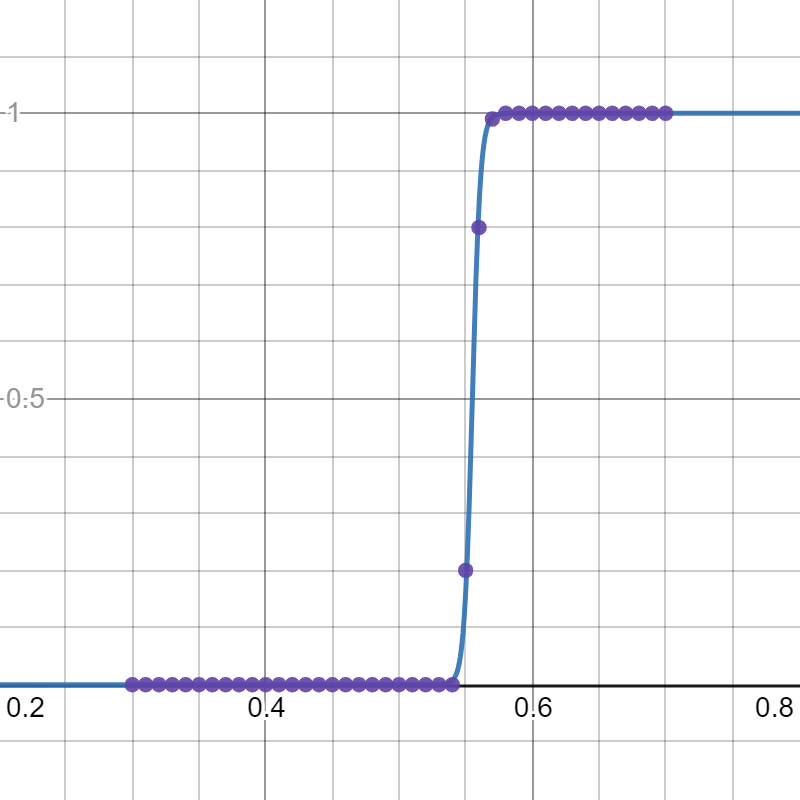
The correlation of the magnets works out to be given by a mathematical function that deserves far more familiarity than it has; Hyperbolic Tangent (tanh). It looks like this:


The smooth transition from one state to the other doesn't seem like a good representation of a phase transition. But it is. The scale of the x axis changes with the number of elements in the simulation. For a large number of particles it looks like this:


One of the most surprising things, at least to me, is that freezing, or ferromagnetism, only happens if there are a large number particles involved. If the number of particles is small instead of there being a sudden transformation from one state to another at a well defined temperature there is a temperature range where the characteristics smoothly change from one state to the other. This behavior is captured very well by the Ising model.

I've made an interactive webpage that shows a similar, but easier to compute system. Imagine a rectangular grid of points that can be connected by a pipe to the points on either side as well as above or below. Think of the top row as a source of water that can flow down, if the connections are there. The question is: Does the water make it to the bottom? Let's look at some examples to make it clear.


In this example there is a 10x10 grid with a 55% probability that any possible connection exists. In this case we see at the bottom of the image the word "Wet" indicating that (at least part of) the bottom row is "Wet". If we press "Simulate" sometimes the results are like the one above, other times like this:


If we run this many times with varying probability and note the fraction of the times the bottom is "Wet" at different probabilities. Here are some results for "small" grid with the probability setting ranging from 0.3-0.7:


The line is a tanh function adjusted to fit. It is very good fit to the points especially since I just eye-balled the adjustments for the tanh function and the data points still have some random noise since I only let the simulations run for a few thousand trials. As we vary the probability of a connection being present from 0.3 to 0.7 the fraction of "wet" final states changes smoothly from 0 to 1.

If we select "Medium" or "Large" the simulation uses 100 x 100 or 100 x 1000 points. As predicted by the Ising model the transition gets sharper and sharper.

Medium                                                               Large


This is instructive when thinking about epidemiology because it highlights a very unintuitive fact. When the percentage of people needed for disease spread to stop, often called "herd immunity" is considered this is not a gradual change. It is very much like the ability of water in the model above to get to the bottom. With a large enough group of people there is a sharp difference between a population that is protected from disease spread and one that is not. If herd immunity requires say, 65% of the population to vaccinated, it isn't true that 60% is pretty close. The population is either herd immune or it isn't.

Friday, June 4, 2021

Decoherence, Measurement, and a Collapse of Understanding

I frequently find myself getting quite upset when reading articles about Quantum Mechanics (QM) in the popular press and related media. This subject is very hard to write about in a way that allows the reader to grasp the elements involved without inviting misconceptions. In many cases I think that these treatments do more harm than good by misinforming more than informing. I know of no way to quantify the misinformation/information ratio but my experience as a science explainer tells me that the ratio is often significantly larger than one.

I recently came across an article that tried to tackle some very difficult topics and, in my opinion at least, failed in almost every case and spectacularly so in a few. There are so many problems with this article I had a lot of trouble deciding what to single out but I finally settled on this:

"However, due to another phenomenon called decoherence, the act of measuring the photon destroys the entanglement."

This conflation of measurement and decoherence is very common and the problems with it are subtle. This error masks so much of what is both known and unknown about the subject it is doing a disservice to the reader by hiding the real story and giving them a filter that will almost certainly distort the subject so that when more progress is made the already difficult material becomes even harder to comprehend.

So, what are "measurement" and "decoherence" in this context and what's wrong with the sentence I quoted? I'm going to try to explain this in a way that is simultaneously, accessible without lots of background, comprehensive enough to cover the various aspects, and, most importantly for me, simple without oversimplifying. 

"Measurement" seems innocuous enough. The word is used in everyday language in various ways that don't cause confusion and that is part of what causes the trouble here. When physicists say "measurement" in this context they have a specific concept, and related problem, in mind. The "Measurement Problem" is a basic unresolved issue that is at the core of the reasons that there are "interpretations" of quantum mechanics. There are lots of details that I'm not mentioning but the basic issue is that quantum mechanics says that once something is measured, if it is quickly measured again, the result will be the same. 

That sounds trivial. How could that be a problem? What else could happen? It is an issue because another fundamental idea in QM is that of superposition: A system can be state where there are a set of probabilities for what result a measurement will get and what actually happens is random. The details of the change from random to determined, caused by a measurement, is not part of the theory. In the interpretation that is both widely taught and widely derided, the Copenhagen Interpretation, the waveform is said to "collapse" as a result of the measurement. To say that this collapse is not well understood is a major understatement.

In summary, a quantum "measurement" can force the system to change its state in some important way. To use examples that you've probably heard: Before a measurement a particle can be both spin-up and spin-down, or at location A and location B, or the cat is both dead and alive. After the measurement the system will be in only one of those choices.

The word "decoherence" is less familiar. It is obviously related to "coherent" so it is natural to think of it as a process where something is changed so that it loses some meaning. A good example would be a run on sentence filled with adjectives and analogies that go at the concept from so many directions that meaning is lost rather than gained. That is not what decoherence is about. To explain what it is I need to provide some details of QM.

Quantum Mechanics can be described as a theory of waves. The mathematical object that encodes everything about a system is called a "wavefunction". Waves are another concept that is pretty familiar. Let's consider something that is familiar to many people: a sine wave.


There are lots of different sine waves, but they differ from each other in just three ways: Amplitude, Wavelength, and Phase. Amplitude is easy, it's just the "height" of the wave. These two waves differ only in amplitude:
Wavelength is easy as well. It is a measure of how "long" each wave is. These two waves differ only in wavelength. The red one is four times "longer" than the blue one:
Phase is less familiar. It is a "shift" in the wave. Here the blue one is "shifted" by 1/4 of a wavelength with respect to the red one. Note that it is the ratio of the wavelength to the shift that is important. Shifting a wave with a short wavelength by a fixed distance has a much bigger effect than one with a long wavelength.
From the perspective of QM these different characteristics are treated in very different ways. Without going into the reasons, here are some of the details. QM has a kind of mathematical automatic gain control. Amplitude is used to compute the probability that a measurement will have a certain value. This gain control ensures that all of those probabilities add to one. It is a bit of an overgeneralization but wavelength is the thing that defines the essential properties of the wave. Using light as an example, the wavelength of the light determines the color and (nearly) everything else about it. Phase is where (much) of the weirdness of QM comes from. Built deeply into the structure of QM there is no way to detect the phase of a wavefunction. Any two quantum mechanical "things" that differ only in phase cannot be distinguished by any measurement of the individual "things". But when they are allowed to interact with each other the effects can be dramatic.

If two waves of the same amplitude and wavelength but different phases are allowed to interact they add together to form a wave of the same wavelength but with an amplitude between zero and double the original amplitude. Here we see what happens if a red and blue wave of the same amplitude and nearly the same phase are added:
The resulting purple wave is about twice the amplitude of the starting wave. If the phases are arranged in a particular way the result is very different.:
The two waves cancel and the result is zero. These waves are said to be "out of phase" and they essentially vanish. As noted above, amplitude relates to the probability of measurement outcomes. If the amplitude is zero, nothing happens. It is as if the object isn't there. This is the essence of the double slit experiment. If you aren't familiar with this (or want a refresher on the subject), the link in the previous sentence gives a good introduction. Another term you will hear is that the waves "interfere" with each other and form an "interference" pattern. The different path lengths provided by the two ways light can reach a given spot on the screen smoothly change the relative phase so the result goes from being "out of phase" and dark to adding up to twice the brightness where there is constructive interference. When waves are combined and their phases have a slowly varying relationship the result is an interference pattern. A set of waves that have a fixed phase relationship are referred to as "coherent".

In this context the term "decoherence" is easier to understand. Decoherence occurs when the fixed relationship between the phases of elements of a system is lost. The phase of a wave is easily changed so this relationship is very delicate. Almost any interaction with the environment will affect it. This results in the destruction of any interference patterns in the results.

To recap, we are looking at two aspects of QM. First we have measurement. A quantum system can be constructed so that it is effectively in two states at once. This is often cited as a particle is spin-up and spin-down at the same time or Schrödinger's cat is both dead and alive. But once the measurement is made the results are stable. The system is seen to "collapse" into a known state. Next, we have decoherence where interactions with the environment cause changes in the phase of quantum waves and prevent interference patterns. 

So, let's look at that sentence again: "However, due to another phenomenon called decoherence, the act of measuring the photon destroys the entanglement.". Some of the possible states of a multi-particle system have a property called "entanglement". That is another topic that richly deserves its own rant but the details don't matter here. All we need to know in this context is that when one element in the system is measured it affects the entire system. In this case the "collapse", caused by the measurement, changes the system so that it is no longer entangled. The loss of entanglement is the result of the measurement. No matter how carefully interactions with the environment, the cause of decoherence, were eliminated the entanglement would still be lost.

If the situation is as simple as I describe, with decoherence relating to phase and measurement relating to collapse why are these concepts so often conflated? I think I understand the reason. 

The article quoted above is an exception but most of the time these concepts are confused it is in the context of why the quantum world and the day-to-day world seem so different. The weirdness of the quantum world is often divided into two categories. First, we have the ability of quantum objects to be in two (or more) states at once and the mysterious "collapse" to only one. Second, we have strange non-local behaviors. The double slit experiment has been done one particle at a time and the interference patterns persist. The particle, in some sense, is going through both slits at the same time. This effect, as described above, is exquisitely dependent on the system remaining coherent. It is easy to see why this effect goes away in the day-to-day world. The wavelength of an object gets smaller as it gets more massive. As noted above it is the ratio of the phase shift compared to the wave length that matters. This makes phase shift effects much larger and we get decoherence. The complexity of the day-to-day world is also important, there are so many particles that the number of possible interactions is enormous.

Less obvious is the first category, superposition and "collapse". There is a lot of work being done to try to explain why superposition and apparent "collapse" of QM aren't part of our normal day-to-day experience. It looks like decoherence is central to this situation as well. The details are subtle but it isn't, as implied by the quote at the start of this post, that decoherence causes the waveform collapse. It is that decoherence effectively removes all but one possible result from the available quantum outcomes. The term for this, explained here, is einselection, a portmanteau of "environment-induced superselection" This far from an easy read but it is, at least in my opinion, about as accessible as it can be. The unfortunate result is that decoherence, has become entwined (you might say entangled but the pun isn't worth it) with the concept of collapse and we get the conflation that this rant is about.

This treatment is far from complete but I hope it makes decoherence more comprehensible and shows how it is distinct from measurement and collapse, at least in the simplest cases.